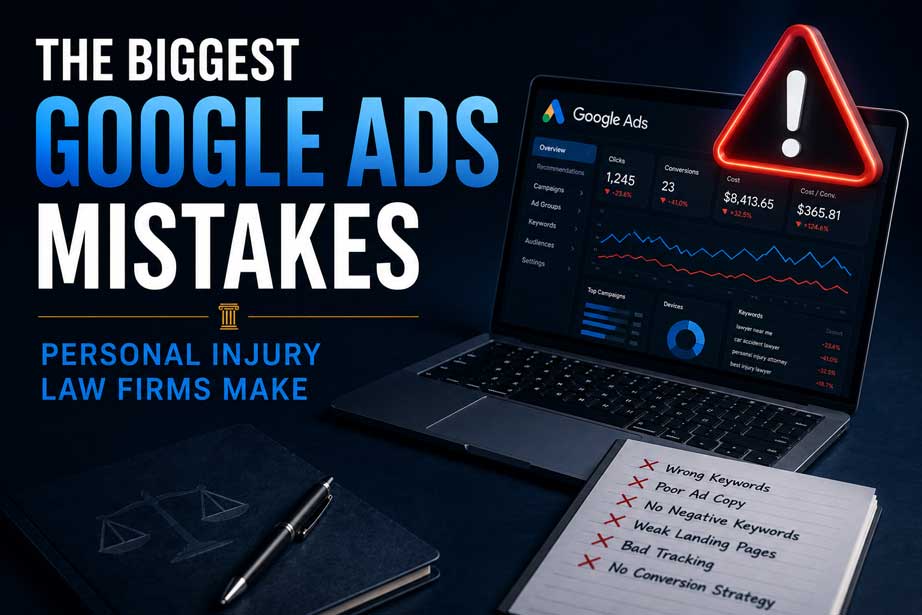
The Biggest Google Ads Mistakes Personal Injury Law Firms Make
Estimated Reading Time: 12 Minutes
Topic: Google Ads
Best For: Personal Injury Attorneys, Managing Partners, Marketing Directors
There are few marketing channels that have generated more signed cases for personal injury law firms than Google Ads.
When managed correctly, Google Ads places your firm in front of people at one of the most important moments imaginable—the exact moment they’re actively searching for legal representation.
That’s incredibly powerful.
It’s also why so many firms become frustrated when their campaigns fail to produce the results they expected.
Over the years, I’ve reviewed Google Ads accounts ranging from a few thousand dollars per month to well over six figures in monthly ad spend. Some were exceptionally well managed. Others were little more than expensive guessing games.
Interestingly, the biggest problems are rarely dramatic.
Most campaigns don’t fail because of one catastrophic mistake.
They underperform because of dozens of small decisions that quietly reduce efficiency over time.
A broad keyword here.
A weak landing page there.
Conversions that aren’t tracked correctly.
Negative keywords that haven’t been updated in months.
None of those problems seems significant on its own.
Together, they can turn a promising campaign into a very expensive disappointment.
The encouraging news is that nearly all of these problems can be corrected once you know where to look.
Mistake #1: Treating Google Ads Like a Slot Machine
One of the first conversations I have with new clients is about expectations.
Some firms approach Google Ads hoping it will produce immediate, dramatic results.
If the campaign doesn’t generate several new cases within the first few weeks, they assume the platform isn’t working.
Google Ads doesn’t work that way.
Successful campaigns are built through testing, refinement, and continuous improvement.
The first month teaches you how people search.
The second month teaches you which messages attract the right prospects.
The following months reveal which keywords produce consultations, which landing pages convert best, and where advertising dollars generate the strongest return.
The firms that consistently succeed understand that optimization is not an event.
It’s an ongoing process.
Mistake #2: Sending Paid Traffic to the Homepage
This is one of the most common mistakes I continue to see.
A prospective client searches for a motorcycle accident lawyer.
They click your advertisement.
Instead of arriving on a page dedicated to motorcycle accident cases, they’re sent to your homepage.
Now they have to search your navigation, locate the appropriate practice area, and decide whether your firm handles their specific situation.
Every additional step creates friction.
And friction reduces conversions.
A dedicated landing page removes those obstacles.
It speaks directly to the visitor’s situation.
It answers the questions they’re already asking.
It establishes credibility quickly.
Most importantly, it gives them one clear action to take.
In my experience, firms that invest in high-quality landing pages almost always see stronger performance than firms relying exclusively on their homepage.
Lesson From the Field
Several years ago, I reviewed an account for a firm that believed Google Ads had simply become too expensive.
The campaign had generated a healthy number of clicks, but consultations had begun to decline.
Their immediate assumption was that costs had increased because of growing competition.
The campaign itself wasn’t perfect, but it wasn’t the primary problem either.
Every advertisement directed visitors to the firm’s homepage.
The homepage looked professional, but it tried to serve every possible audience—car accidents, truck accidents, workers’ compensation, wrongful death, medical malpractice, and several other practice areas.
Visitors were being asked to do the work.
Once we replaced those generic destinations with dedicated landing pages focused on the specific search intent behind each advertisement, consultation rates improved significantly.
The advertising budget remained essentially the same.
The experience improved.
That’s an important distinction.
Google Ads doesn’t simply generate traffic.
It creates opportunities.
Your landing page determines what happens next.
Mistake #3: Measuring Clicks Instead of Clients
Google Ads provides an extraordinary amount of data.
Clicks.
Impressions.
Click-through rates.
Average cost per click.
Quality Score.
Conversion rates.
Those numbers are useful.
But none of them tells you whether your marketing is actually helping your firm grow.
I’ve seen campaigns with impressive click-through rates that produced very few signed cases.
I’ve also seen campaigns with average-looking metrics that consistently generated exceptional cases.
Business owners don’t deposit click-through rates into the bank.
They build successful firms by signing qualified clients.
That’s why I encourage attorneys to ask different questions.
Which keywords generate consultations?
Which campaigns produce signed cases?
Which practice areas create the strongest return on investment?
Once you begin measuring business outcomes instead of advertising activity, your decision-making becomes much clearer.
Mistake #4: Trying to Reach Everyone
One temptation within Google Ads is expanding keyword lists as much as possible.
The reasoning sounds logical.
More keywords should produce more traffic.
More traffic should produce more clients.
Unfortunately, it rarely works that way.
Broad campaigns often attract people outside your target market.
Someone looking for free legal advice.
Someone researching an accident that happened years ago.
Someone searching for information rather than representation.
Every irrelevant click consumes part of your advertising budget.
That’s why specificity matters.
A carefully structured campaign targeting qualified search intent will almost always outperform a campaign trying to appear for every possible legal search.
More traffic isn’t the objective.
Better traffic is.
Mistake #5: Ignoring Negative Keywords
Negative keywords rarely receive much attention because they aren’t particularly exciting.
They don’t create advertisements.
They don’t increase impressions.
They don’t generate headlines.
What they do is protect your advertising budget.
Every irrelevant search your ads avoid is money preserved for someone genuinely looking for a personal injury attorney.
Over time, that discipline can have a meaningful impact on campaign performance.
One of the simplest ways to improve efficiency is reviewing search terms regularly and adding negative keywords whenever inappropriate traffic begins appearing.
It’s not glamorous work.
It’s simply part of building a disciplined advertising campaign.
Mistake #6: Not Tracking What Actually Matters
One of the first questions I ask when reviewing a Google Ads account is surprisingly simple.
“What happens after someone clicks your ad?”
You’d be amazed how often the answer is vague.
Many firms know how many clicks they’re receiving.
Some know how many phone calls they’re generating.
Far fewer know how many of those calls became consultations.
Even fewer know how many consultations became signed cases.
Without that information, you’re making decisions with only part of the picture.
Imagine running a successful trial without knowing the jury’s verdict.
That’s essentially what many firms are doing with their marketing.
Google Ads can tell you what happened before someone contacted your office.
Your intake and case management systems tell you what happened afterward.
Only when those two systems work together can you accurately measure return on investment.
Mistake #7: Making Major Changes Too Quickly
One mistake I continue to see is changing too many variables at the same time.
A campaign underperforms for two weeks.
The keywords change.
The bidding strategy changes.
The advertisements change.
The landing page changes.
The budget changes.
Now it’s impossible to know which adjustment actually affected performance.
Disciplined optimization is usually slower than people expect.
The best campaign managers make one meaningful improvement, measure the results, and allow enough time for reliable data to accumulate before making another decision.
Patience may not be exciting.
It’s often profitable.
The First Five Things I Review During Every Google Ads Audit
People occasionally ask me what I look at first when evaluating a campaign.
Interestingly, it’s usually not the advertisements.
Here’s where I begin.
1. Is the campaign attracting the right search intent?
Before looking at anything else, I want to know who the campaign is actually reaching.
Generating traffic is easy.
Generating qualified traffic requires precision.
2. Where does the advertisement send visitors?
Landing pages matter.
If someone searches for a truck accident attorney, I want them arriving on a page that speaks directly to truck accident cases—not a generic homepage.
Search intent and landing page experience should always match.
3. How are conversions being measured?
If we aren’t tracking meaningful actions accurately, every other decision becomes more difficult.
Reliable data is the foundation of good optimization.
4. What happens after the phone rings?
This question appears in almost every audit I perform.
Advertising creates opportunities.
Intake determines what happens next.
If qualified prospects aren’t receiving an exceptional first experience, improving Google Ads alone won’t solve the problem.
5. Are we measuring signed cases or simply celebrating leads?
This may be the most important question of all.
Marketing exists to help law firms grow.
Signed cases—not clicks—are ultimately what matter.
Lesson From the Field
I once reviewed an account where the attorney believed the campaign needed a larger budget.
The numbers looked convincing.
Traffic had slowed slightly, competitors appeared more aggressive, and cost per click had increased.
Those observations were accurate.
They simply weren’t the primary issue.
During the review, we discovered something much more significant.
The campaign contained hundreds of keywords that had accumulated over several years.
Many were only loosely related to personal injury law.
Some hadn’t generated meaningful conversions in a very long time.
Others attracted informational searches rather than people actively looking for representation.
Instead of increasing the budget, we simplified the campaign.
We removed unnecessary complexity.
We tightened keyword targeting.
We refined the landing pages.
We strengthened negative keyword management.
The result wasn’t dramatic overnight.
It was something much more valuable.
Steady improvement.
Within a few months, the campaign became considerably more efficient without requiring a significant increase in advertising spend.
That experience reinforced another lesson I’ve carried with me ever since.
Better campaigns are usually simpler campaigns.
Simplicity Often Wins
There’s a temptation in digital marketing to believe complexity equals expertise.
Thousands of keywords.
Dozens of campaigns.
Countless automated rules.
Complicated bidding strategies.
Sometimes those things are necessary.
Often they aren’t.
Some of the strongest-performing campaigns I’ve reviewed were surprisingly straightforward.
Clear campaign structure.
Highly relevant keywords.
Excellent landing pages.
Consistent optimization.
Reliable conversion tracking.
Strong intake.
That’s not glamorous.
It is effective.
Google Ads Is Only One Piece of the Puzzle
I enjoy working with Google Ads because it remains one of the most powerful client acquisition platforms available to personal injury law firms.
But it’s important to remember what Google Ads actually does.
It introduces qualified prospects to your firm.
Everything after that depends on the experience you provide.
The landing page.
The phone conversation.
The consultation.
The follow-up.
The attorney.
The firms that consistently outperform their competitors understand that advertising doesn’t operate independently.
It functions as part of a much larger client acquisition system.
That’s why I rarely evaluate Google Ads in isolation.
I evaluate the entire journey.
Final Thoughts
When people ask me whether Google Ads still works for personal injury law firms, my answer is almost always the same.
Absolutely.
When it’s built correctly.
When it’s monitored consistently.
When it’s connected to outstanding landing pages.
When it’s supported by exceptional intake.
And when success is measured by signed cases rather than advertising statistics.
Google Ads hasn’t stopped working.
In many situations, the system surrounding it simply needs attention.
Key Takeaways
- Successful Google Ads campaigns are built through continuous refinement—not quick fixes.
- Dedicated landing pages consistently outperform sending paid traffic to a generic homepage.
- Measure signed cases, consultations, and meaningful business outcomes rather than focusing exclusively on advertising metrics.
- Simpler, well-organized campaigns often outperform unnecessarily complex account structures.
- Google Ads performs best when it’s integrated into a complete client acquisition system.
Continue Your Learning
Next Article
Why Sending Paid Traffic to Your Homepage Is Costing You Cases
In the next article, we’ll examine one of the most common—and most expensive—mistakes law firms make with paid advertising, and explain why dedicated landing pages consistently outperform general websites.
Steve’s Take
One of the biggest misconceptions I encounter is the belief that Google Ads can solve every marketing problem.
It can’t.
Google Ads is exceptionally good at putting your firm in front of people who are actively searching for legal representation.
What happens after they click is entirely up to your firm.
That’s why I never evaluate a campaign based solely on clicks, impressions, or cost per lead.
I evaluate whether the entire client acquisition process is working together.
Because in my experience, successful marketing doesn’t happen when one part of the system performs well.
It happens when every part of the system supports the next.
Ready to Take a Closer Look?
Every law firm’s marketing system is different.
Some firms need stronger Google Ads. Others need more effective landing pages, better-trained intake professionals, or a more consistent follow-up process. The challenge isn’t making assumptions—it’s identifying where qualified opportunities are being lost.
That’s exactly what our Complimentary Case Growth Review is designed to do.
We begin by listening to your goals, then evaluate your advertising, landing pages, intake process, follow-up strategy, and overall client acquisition system with an analytical eye. The result is a clear understanding of what’s working, what isn’t, and where the greatest opportunities for improvement exist.
Whether you decide to work with Legal Pro Media or simply use our recommendations to strengthen your current marketing, you’ll walk away with a better understanding of how your firm’s marketing system is performing.
Request Your Complimentary Case Growth Review →